
Braga, the third-largest city in Portugal, is affectionately known as the “Capital of Minho” or simply the “Heart of Minho.” It holds a fascinating dual identity: it is considered one of the youngest cities in Europe due to its vibrant, youthful population, yet one of the oldest in the world, with a history spanning over 2,000 years. Originally founded as Bracara Augusta by Emperor Augustus, Braga was strategically located on one of the main Roman roads of the Iberian Peninsula and served as the administrative heart of the Empire.
At the center of Braga stands its iconic Cathedral, the oldest in Portugal, constructed in the 12th century by the parents of the first King of Portugal. The city is also home to the Biscainhos Museum, a Baroque palace showcasing Braga’s most striking architectural period, and the D. Diogo de Sousa Archaeological Museum, which preserves the city’s rich Roman heritage.
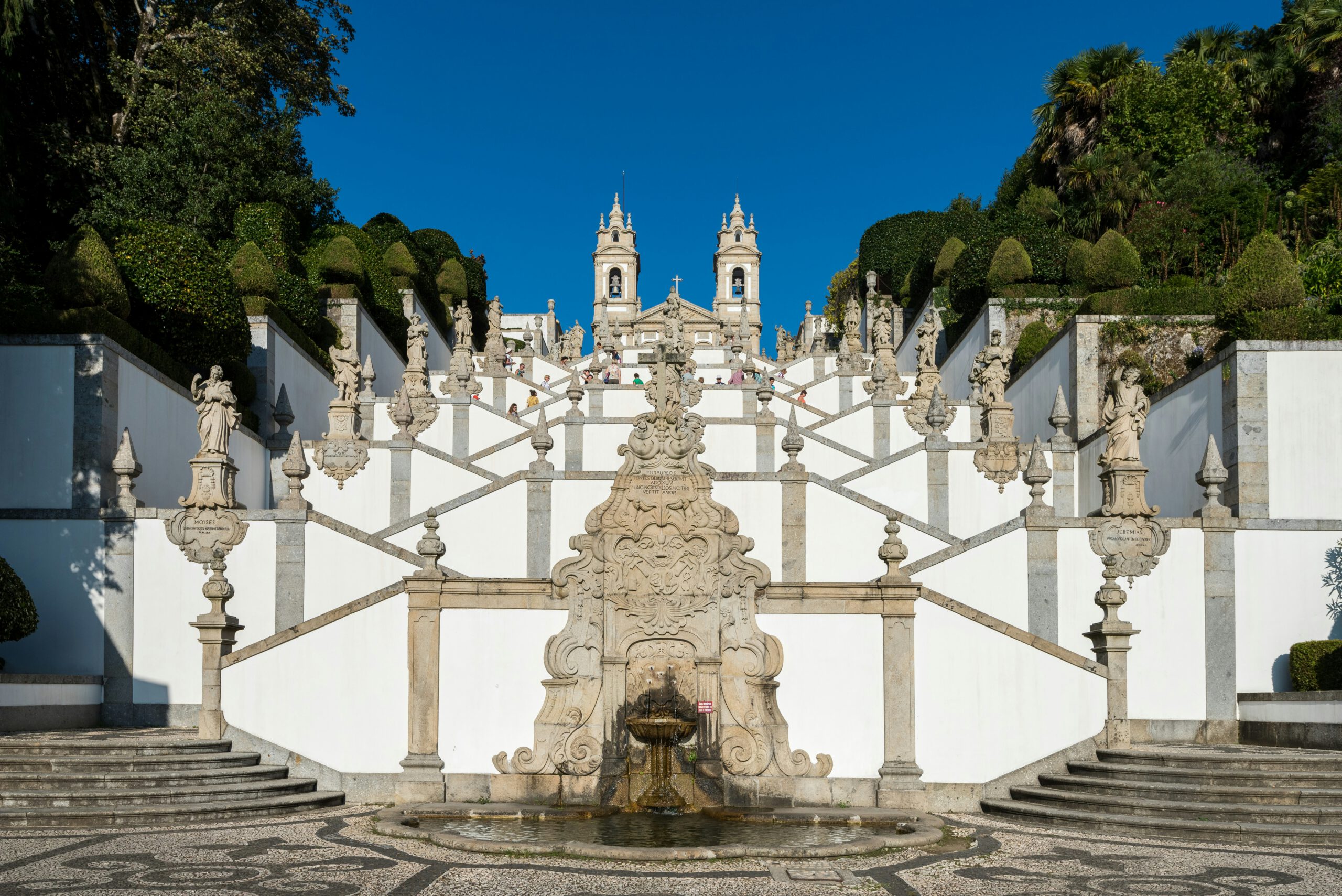
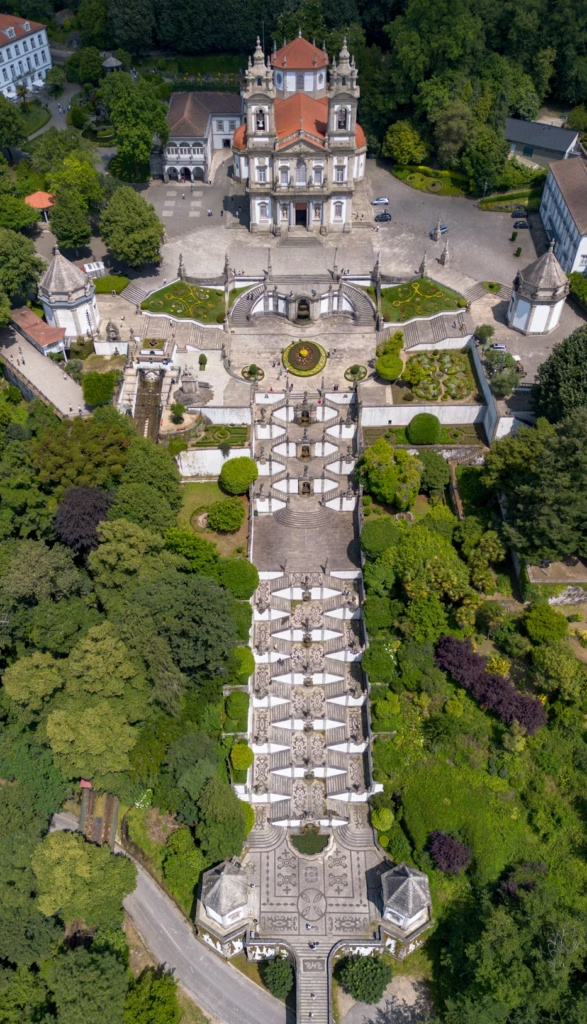
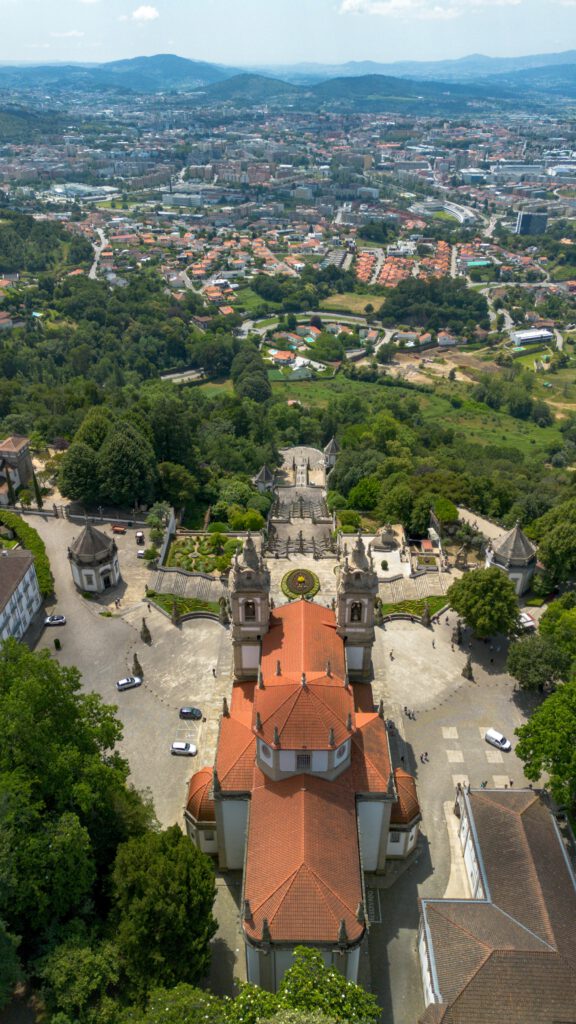
Often called the “Portuguese Rome,” Braga’s Roman legacy is one of its most captivating features. A stroll through the historical center reveals a wealth of churches, historical houses, and landmarks such as the Palácio do Raio, Theatro Circo, and the Arch of Porta Nova. Take a break at the emblematic Café A Brasileira, overlooking the lively Central Avenue, and soak in the city’s atmosphere. As one of the oldest Christian cities in the world, Braga boasts a vast religious heritage, epitomized by the Sanctuary of Bom Jesus do Monte, a masterpiece of European Baroque.
Visitors can reach the Sanctuary by foot, by car, or via the funicular. The stairway to the top consists of 17 levels adorned with symbolic fountains, allegorical statues, and intricate Baroque decorations depicting religious themes. At the summit, eight figures represent the participants in the Condemnation of Jesus. Don’t miss the breathtaking perspective from the base of the staircase: the granite fountains stand out in white, forming a chalice that supports the church above.
Braga is also renowned for its traditional crafts. Beyond ukuleles, violas, and sacred art, local artisans produce exquisite linen items, intricate embroidery, wooden miniatures, the “farricocos” masks, and the famous votive candles, all crafted with knowledge passed down through generations.
Regional delicacies
Frigideiras de Braga; Abade de Priscos pudding


No visit to Braga would be complete without sampling its exceptional gastronomy. Pastries and desserts reflect originality and refinement, with the legendary “Abade de Priscos” pudding as a highlight. Codfish reigns supreme among savory dishes, from Codfish à Narcisa to Codfish à Minhota, and the hearty sarrabulho with pork pairs perfectly with a glass of refreshing Vinho Verde.
Braga is a city where history, devotion, and culture converge, offering visitors an immersive journey through time. Its unique blend of tradition and modernity ensures that every corner holds a story, making Braga a truly unmissable destination.
Not to be missed ...
Cathedral; Santuary of Sameiro; Santuary of Bom Jesus; Santa Cruz Church; Monastery of S. Martinho de Tibães; Basílic of São Martinho de Dume; Roman baths of Maximinos; Old School of the Cathedral Domus; Museum of Archaeology D. Diogo de Sousa; Great Tower or Donjon